axxessp.r1@gmail.com
Thornton, Colorado




October 15, 2026
Paint Color Consulting in Denver: Test Light First
TL;DR
- The same paint color can look like three different colors in one Denver home, because room direction, season and light bulbs all change what your eyes see.
- Check a color's light reflectance value (LRV) before you fall in love with its name. It tells you how much light the paint bounces back into the room.
- Test large samples on more than one wall and look at them in the morning, afternoon and evening before you buy a single gallon.
- AXXESS Painting and Remodeling offers color consulting as part of its interior painting work for homeowners in the Denver area. Call (720) 226-5092 for a free estimate.
Paint color consulting in Denver comes down to one idea: choose the color for the light in your room, not for the chip in your hand. A soft gray that looks calm in the store can turn cold and blue in a north-facing bedroom, then look warm and bright in a south-facing living room.
AXXESS Painting and Remodeling, based in Thornton, Colorado, offers color consulting alongside interior painting for homeowners across the Denver area. This guide explains how light changes color, how to read an LRV number, how to test samples properly, and how to pick whites, trim and accent colors that work together. If you are repainting soon, it will save you from the most common and most expensive mistake: painting the whole room and then disliking the shade.
For the full list of painting work AXXESS handles, see the interior and exterior painting page.
What does paint color consulting in Denver actually cover?
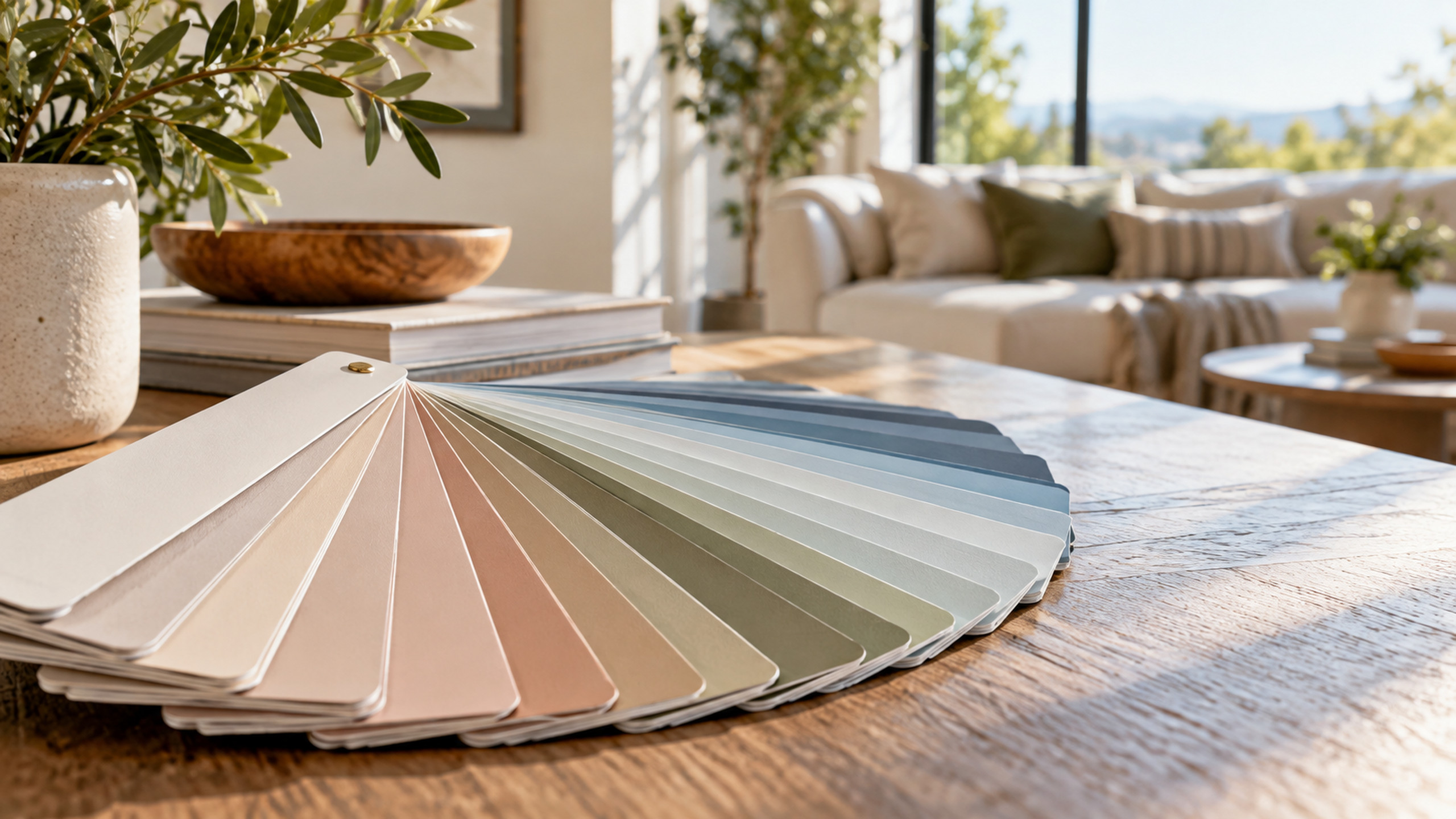
Paint color consulting is help choosing wall, trim and accent colors that suit your room's light, your furnishings and the look you want. A good consultation narrows dozens of options to a short list, explains why each one works, and has you test those colors in the actual room before painting.
That last part matters most. A color consultant is not guessing from a photo. The goal is to move you from "I like this color" to "I know this color works in this room."
In practice, color help usually covers a few decisions:
- Wall color: The main shade for each room, chosen with the room's light and your furniture in mind.
- Trim and ceiling color: The white or off-white that frames the walls. This choice changes how the wall color reads.
- Accent colors: A feature wall, a door, built-ins or a dining room that can handle a deeper shade.
- Flow between rooms: How colors connect through hallways, stairs and open floor plans so the house feels planned instead of patched together.
If you want AXXESS to help with color on your project, mention it when you request your free estimate. It is easiest to settle color early, before prep and scheduling begin.
Why does the same paint color look different in every Denver room?
Paint color changes with the light that hits it. Light varies by the direction your windows face, the time of day and the season. Each of those shifts the color's brightness and its warm or cool cast, so one gallon of paint can look like different colors in different rooms of the same house.
Denver adds one more reason to take this seriously. Fox Weather reports that Denver averages about 245 sunny days a year, and it calls the popular "300 days of sunshine" claim a myth. Even at 245, that is a lot of strong direct light, and strong light exposes every undertone in a paint color.

How does room direction change paint color?
Painters and paint brands describe the same pattern. Benjamin Moore says light from each direction "has a powerful effect on a paint colour's intensity and cast," and that a north-facing room "tends to get consistent light throughout the day." Here is how the main exposures tend to behave, based on the guidance from the sources linked below.
- North-facing rooms: Benjamin Moore says northern light can be "muted and toned down" and has a cool, blue cast. It suggests a clean, fresh white with a hint of yellow to offset that. Farrow and Ball designer Charlotte Cosby says north-facing rooms get little light, which brings out cooler gray and green undertones.
- South-facing rooms: Cosby says south-facing rooms are brighter and warmer, so soft off-whites and pale aquas suit them.
- West-facing rooms: Sue Wadden of Sherwin-Williams says a west-facing room "can look dull and shadowy in the morning but be bathed in a warm glow in the evening."
- East-facing rooms: The sources above do not give a separate rule for east light. The practical takeaway is the same as for west: the room changes a lot between morning and evening, so test at both times.
Does the season change how paint looks?
Yes. Benjamin Moore notes that winter light "tends to be cooler and sharper than natural light during the summer." A color you approve on a golden August afternoon can look flatter and cooler on a gray January morning. If you are choosing color in autumn, keep that winter shift in mind and test the sample again on a cloudy day.
The takeaway is simple. Never judge a color in one spot at one time. Judge it in the room where it will live, across a full day.
What is LRV and why should you check it before choosing a color?
LRV stands for light reflectance value. It is a number from 0 to 100 that shows how much visible light a paint color reflects back into the room. Higher numbers reflect more light and feel brighter. Lower numbers absorb more light and feel deeper. Most paint brands list the LRV on the color chip or website.
PaintDB describes the scale this way: 0 is pure black that absorbs all light, and 100 is pure white that reflects all of it. Real paints do not reach either end. It says the brightest commercial whites top out around 90 to 94, and the deepest blacks bottom out around 3 to 6.
How do you read an LRV number?
PaintDB groups the scale into rough zones. Use them as a starting point, not a strict rule.
- 80 to 100: Whites and the brightest off-whites. These make a room feel larger and brighter.
- 60 to 79: Light neutrals, the most common choice for living spaces.
- 40 to 59: Mid-tones that add visible color without feeling dark.
- 20 to 39: Saturated colors that make a room feel cozier.
- Under 20: Deep, dramatic colors that need layered lighting to look their best.
How do you use LRV to match color to light?
PaintDB gives three practical rules. First, when you compare two candidate colors, compare their LRVs before their names. A gap of more than 10 points means you are choosing between different design ideas, not two similar shades.
Second, match LRV to your light. It suggests warm colors in roughly the 60 to 80 range for north-facing rooms, and mid-range values of 40 to 65 for east- and west-facing rooms, which get strong light at some hours and dim light at others.
Third, keep contrast with your trim. Designers suggest a wall LRV at least 10 points lower than the brightest surface you want to highlight, and walls and trim within about 5 points of each other can make a room look flat.
LRV does not replace your eyes. It helps you cut a stack of 30 chips down to five worth testing. Undertone still matters, because two colors with the same LRV can feel warm and inviting or cool and crisp.
How do you test paint samples the right way?
Test paint on large samples, on at least two different walls, and look at them at several times of day. Use oversized swatches or paint a sample onto poster board so you can move it around the room. Judge the color next to your floors, trim and furniture, not against a bare white wall.

Benjamin Moore recommends buying samples first, in oversized swatch, peel-and-stick or brush-on form. For brush-on samples it advises painting "a foam poster board so you can easily move it around." It also says to see how your colors look "under your home's unique lighting conditions throughout the day and evening."
What is a good sample testing routine?
- Use big samples: A tiny chip hides undertones. A large swatch or painted board shows the real color.
- Test every wall that matters: Put samples on the wall that gets the most light and the wall that gets the least. Farrow and Ball's Cosby advises trying swatches around the room so you can see them in different lights.
- Look three times a day: Check morning, mid-afternoon and evening, since Behr's Erika Woelfel recommends viewing samples in your space at different times of the day.
- Look with the lights on and off: Evening is when bulbs, not windows, control the color.
- Wait a day: Live with the samples for at least a full day before you decide. A color you love at first glance can wear on you.
- Test on a gray day too: Winter light is sharper and cooler, so a cloudy day shows how the color behaves when the sun is not helping.
Painting two coats on the sample board matters too. One thin coat can look lighter and streaky, which gives you a false read on the final color.
How do light bulbs change interior paint color?
Light bulbs change paint color because every bulb gives off a different color of light. Warm bulbs bring out yellow undertones. Cool, bluer bulbs make colors look colder. If you choose paint under one kind of light and live under another, the finished room will not match your expectations.
Behr's Erika Woelfel explains: "Warm artificial lighting tends to emphasize the yellow undertones." Craig and Rose designer Flora Hogg links colors that look colder or bluer to cool white bulbs at 4000K or higher. She recommends "swapping them out for warm light bulbs at around 2000-3000K."
Kelvin (K) is the scale that describes how warm or cool a bulb's light looks. Lower numbers look warmer and yellower. Higher numbers look cooler and bluer. The number is printed on most bulb packaging.
Which bulb should you choose before you test?
- Warm bulbs (around 2000K to 3000K): Cozy and yellow-leaning. They suit bedrooms and living rooms, and they push cream and beige colors warmer.
- Cool bulbs (4000K and up): Crisp and bluish. They can make grays and whites look colder, which is why they are common in kitchens and garages but can feel stark in living areas.
- Mixed bulbs in one room: Mixed temperatures make colors read unevenly across the room. Swap every bulb in the room to the same temperature before you judge your samples.
Make the bulb decision first, then test paint. Otherwise you are choosing a color for a light you may change later.
How do you pick whites, trim and accent colors that work together?
Start with the walls, then choose trim, then add accents. Pick a trim white that sits clearly lighter than the wall color, and check its undertone against the wall. Save deeper accent colors for one wall or one room, where they add depth without making the house feel dark.
Most color regrets come from the whites, not the bold colors. A white that looks neutral on a chip can turn pink, yellow or blue next to your wall color. Test your trim white right beside the wall sample, on the same board if you can.
What about accent walls and bold colors?
Deeper colors have low LRV, so they absorb light. PaintDB says colors under 20 are deep and dramatic and need layered lighting. That points to a few simple rules:
- Dining rooms and dens: Good places for deeper color, since you use them mostly in the evening under lamps and fixtures.
- Rooms with big windows: A deep accent wall can handle strong daylight better than a deep color in a dark room.
- Small, dim rooms: A very dark shade can make them feel smaller. A mid-tone in the 40 to 59 LRV zone is a safer way to add color.
The same thinking works in other rooms of the house. If you are comparing a color plan for your kitchen, our post on two-tone kitchen cabinets looks at pairing two colors on kitchen cabinets.
How do you keep color consistent through a whole house?
Walk through your home as if you were a guest and note every place where two colors meet: hallways, stairwells, open living and dining areas. Those transitions are where mismatched undertones show up. Pick a small family of related colors and use them across rooms, changing the depth from room to room rather than the whole palette.
For exterior color decisions, which follow different rules, see our guide to choosing exterior paint colors for Colorado's climate.
When should you ask a painter for color help?
Ask for color help before you buy paint and before walls are prepped. Color affects how many coats you need, which primer makes sense and how trim should be finished. Deciding color early keeps the schedule clean and avoids a stop in the middle of a job.
AXXESS Painting and Remodeling is licensed and fully insured, uses premium materials and techniques, and follows a four-step service process that ends with a final walkthrough. Color consulting is one of the services the company offers alongside interior painting, exterior painting, cabinet painting, trim and doors, drywall repair and prep, and light remodeling.
What should you do before a color consultation?
You will get more from any color conversation if you arrive prepared. A few small steps help:
- Note which way each room faces: Even a rough note of north, south, east or west helps.
- Gather the fixed items: Think flooring, countertops, tile, cabinets and large furniture. The paint must work with those, because they are not changing.
- Check your bulbs: Write down whether they are warm or cool, or swap them to a single temperature first.
Color is also tied to prep. Fresh color on damaged walls will not look right, so repair work often comes first. Our guides on preparing your home for interior painters and drywall repair before painting explain what to do before the first coat goes on. If your home is older, see our post on lead-safe prep for interior painting.
Frequently asked questions
How much does paint color consulting cost in Denver?
Pricing varies by company and by the size of the project, so there is no single Denver number to quote. AXXESS offers color consulting as part of its painting services. The easiest way to find out what applies to your home is to request a free estimate at (720) 226-5092 or through the contact page.
What is the best paint color for a north-facing room in Denver?
There is no single best color, but the guidance is consistent. Benjamin Moore suggests a clean, fresh white with a hint of yellow to offset the cool cast of northern light, and PaintDB suggests warm colors with an LRV of roughly 60 to 80. Always test the color on the actual wall first.
How many paint samples should I test before choosing?
Test a short list of three to five colors rather than a dozen. Narrow the field using LRV and undertone first, then test each finalist on two walls and look at them in the morning, afternoon and evening. More samples can make the decision harder rather than easier.
Do I need to change my light bulbs before picking paint?
If you have a mix of warm and cool bulbs in the room, yes. Switch them all to one temperature first, since cool bulbs at 4000K or higher can make colors look colder and warm bulbs bring out yellow undertones. Then test your samples under the lighting you plan to keep.
Should the trim be the same color as the walls?
Not usually. A trim color that is clearly lighter than the walls creates contrast and makes the room look finished. PaintDB notes that walls and trim within about 5 points of each other can make a room look flat. Test the trim color next to the wall color.
Does AXXESS serve Denver?
Yes. AXXESS Painting and Remodeling lists Denver in its service area and is based in Thornton, Colorado. Use the contact page or call (720) 226-5092 to ask about your address and schedule.
Ready to pick colors you will still like next winter?
The best paint color is the one that works in your light, with your floors and bulbs, across all four seasons. Test big samples, check the LRV, settle on your bulbs and take your time. A few extra days of testing costs far less than repainting a room.
To get color help with your Denver-area painting project, request a free estimate from AXXESS Painting and Remodeling. Call (720) 226-5092 or use the free estimate page. You can also read more about the company before you call.
